The best stops on the drive from Miami to Key West are what make the Overseas Highway feel like part of the trip instead of just the long road you take before reaching Key West.
There are beaches, state parks, key lime pie stops, wildlife areas, bridge views, roadside attractions, and at least one tree that has become famous enough to make this list.
Yes, a tree made the list.
This guide breaks down the best stops on the drive from Miami to Key West in the order you will reach them, starting in Key Largo and continuing through Islamorada, Marathon, Big Pine Key, and the Lower Keys.
You absolutely do not need to stop at every single one. In fact, unless you are spreading the drive over a full day or two, you probably should not. But choosing a few stops can make the drive feel memorable without turning the day into a 14-hour scavenger hunt.
If you are still planning the Key West part of your trip too, I would also keep my Key West Travel Guide for First Time Visitors open while you map everything out.
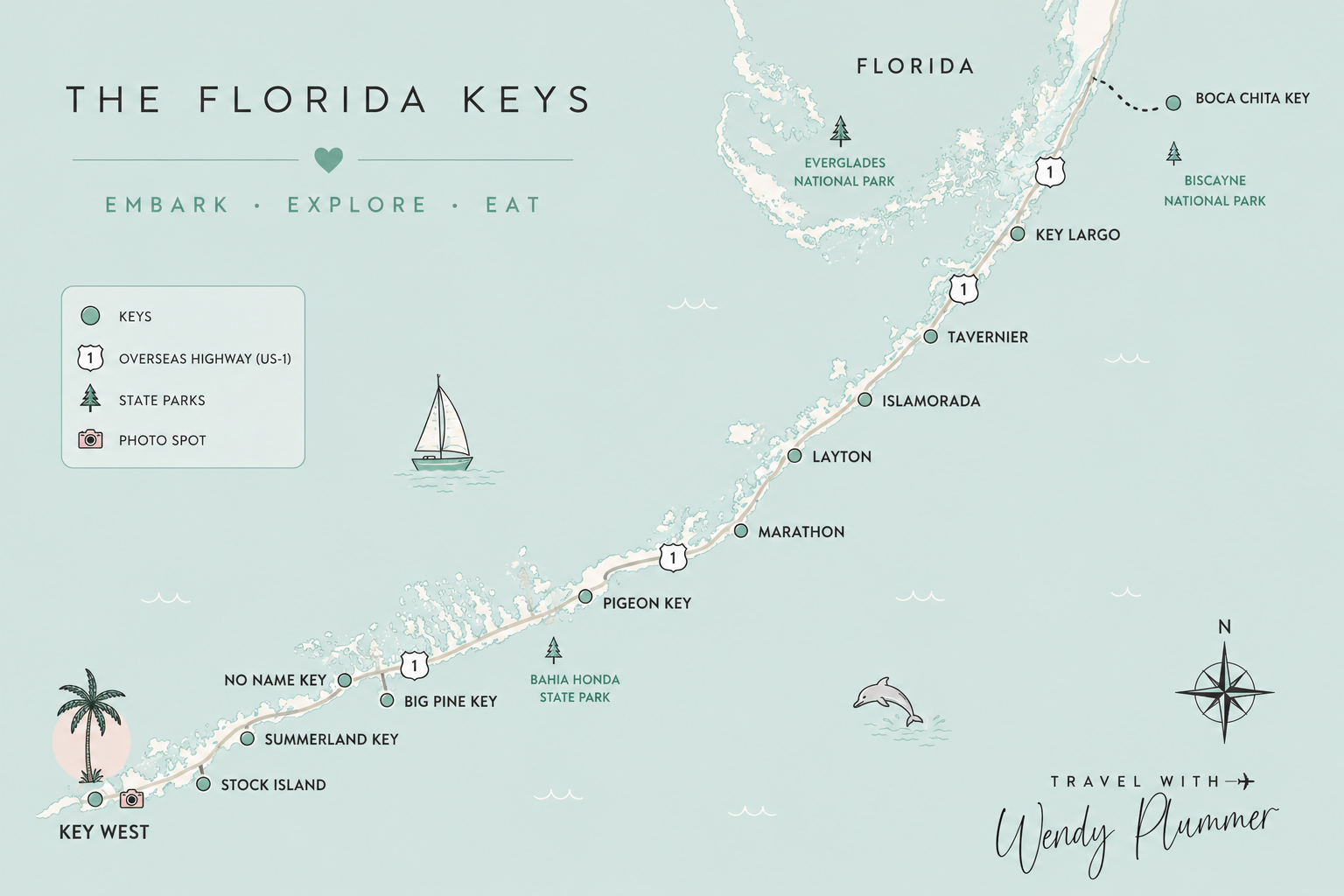
The drive from Miami to Key West is about 160 miles and usually takes around 3.5 to 4 hours without major stops.
That said, traffic, speed limits, drawbridges, and sightseeing stops can make it feel longer. If you want to stop for lunch, key lime pie, beach time, photos, or wildlife viewing, I would give yourself most of the day.
The Florida Keys are not a place where I would want to rush the drive. The water views, bridges, and small roadside stops are a huge part of the experience.
If you want to do this as an actual Florida Keys road trip with stops along the way, you need a car.
There are buses and shuttles between Miami and Key West, but they are not practical if you want to hop between beaches, state parks, key lime pie stops, roadside attractions, and wildlife areas.
This is not a must-stop, but I do understand the appeal if you are someone who likes visitor centers.
I always like visitor centers for the maps, brochures, random shopping, and quick trip-planning pause, so the Florida Keys Visitor Center can be a practical first stop if you want activity info, coupons, or a souvenir before driving farther south.
Would I stop here just to figure out where to go? Probably not, especially if you already have this guide pulled up.
But if you enjoy visitor centers, want a quick bathroom/stretch break, or like grabbing a few brochures before a road trip, it can be a short and easy first stop.
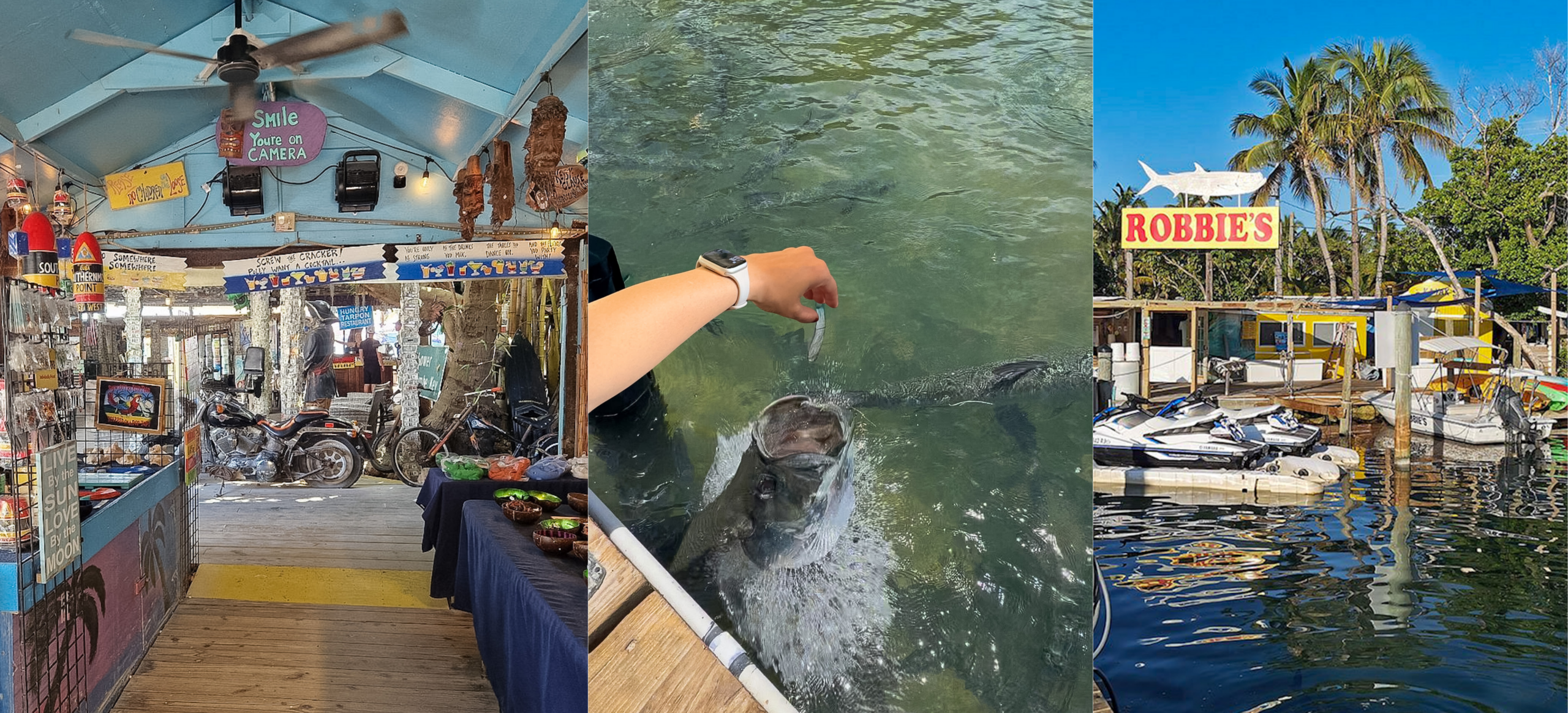
Robbie’s Marina is probably the most famous stop in the Florida Keys.
Visitors come from all over to feed the giant tarpon that gather around the docks. Even if you do not feed the fish yourself, it is entertaining to watch.
The marina also has shopping, local vendors, boat tours, fishing charters, and waterfront views.
This is one of the easiest places to get that classic Florida Keys atmosphere in one stop: boats, fish, salty air, casual shops, and people standing on the dock watching giant tarpon like this is a completely normal activity.
To be fair, it is very entertaining.
If you want to add a boat tour, snorkeling trip, or fishing charter to your Florida Keys itinerary, this is a good area to compare options through Viator or Get Your Guide.
If you are starting your Florida Keys road trip in Key Largo, John Pennekamp Coral Reef State Park is one of the most popular stops.
It is known as America’s first underwater park and is best known for snorkeling, kayaking, paddleboarding, glass-bottom boat tours, and wildlife viewing.
If you have extra time, this is one of the better places to actually get on the water near the beginning of the drive. If you do not have time for a full activity, it can still be a nice place to stretch your legs and get your first real taste of the Keys.
This stop works best if you are not trying to rush straight to Key West. Boat tours and water activities take time, so I would only include this if you are giving yourself a slower travel day.
If you plan to snorkel or kayak during your Florida Keys road trip, I would pack a snorkel mask, reef-friendly spray sunscreen, and a dry bag for beach days. This is not the part of the trip where I would want my phone, wallet, and car keys having a dramatic saltwater moment.
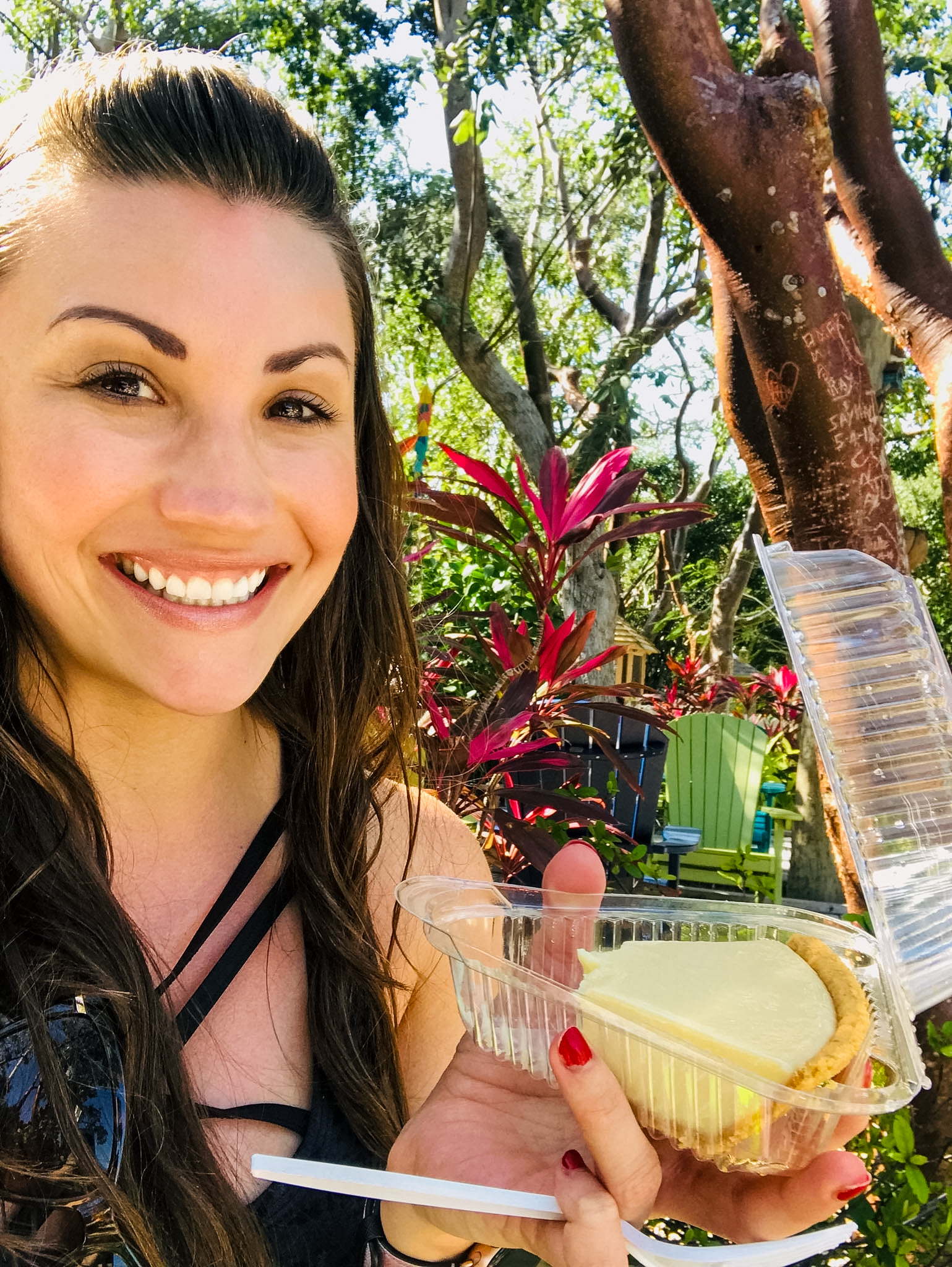
If you are a key lime pie fan, Blonde Giraffe Key Lime Pie Factory is a stop I would absolute must. They serve several versions of their award-winning key lime pie, including traditional, whipped cream, and meringue varieties.
I accidentally ordered mine without whipped cream and immediately regretted it because I think it would have pushed the pie into 10/10 territory.
The filling had a great balance of sweetness and tartness, and the crust was rich, buttery, and slightly nutty. Even without the whipped cream, it was one of my favorite pies in the Florida Keys.
They also sell chocolate-dipped frozen key lime pie on a stick, key lime pie cookies, candies, and plenty of Key lime-themed gifts.
This is an easy food stop because you do not need to commit to a full meal. You can grab pie, walk around for a few minutes, and get back on the road. Excellent decision honestly.
If you are planning to eat your way through Key West too, I also have a full Best Key Lime Pie in Key West guide.
If you enjoy local art, galleries, and creative spaces, consider stopping at Morada Way Arts District in Islamorada.
This small arts district showcases local artists and gives you a different side of the Keys beyond beaches, snorkeling, and boat tours.
It is a good stop if you want something low-key, especially if you like browsing galleries or picking up something more unique than the usual souvenir shop items.
I would not necessarily make this your only Islamorada stop if you are short on time, but it is a nice addition if you are already slowing down in the area.
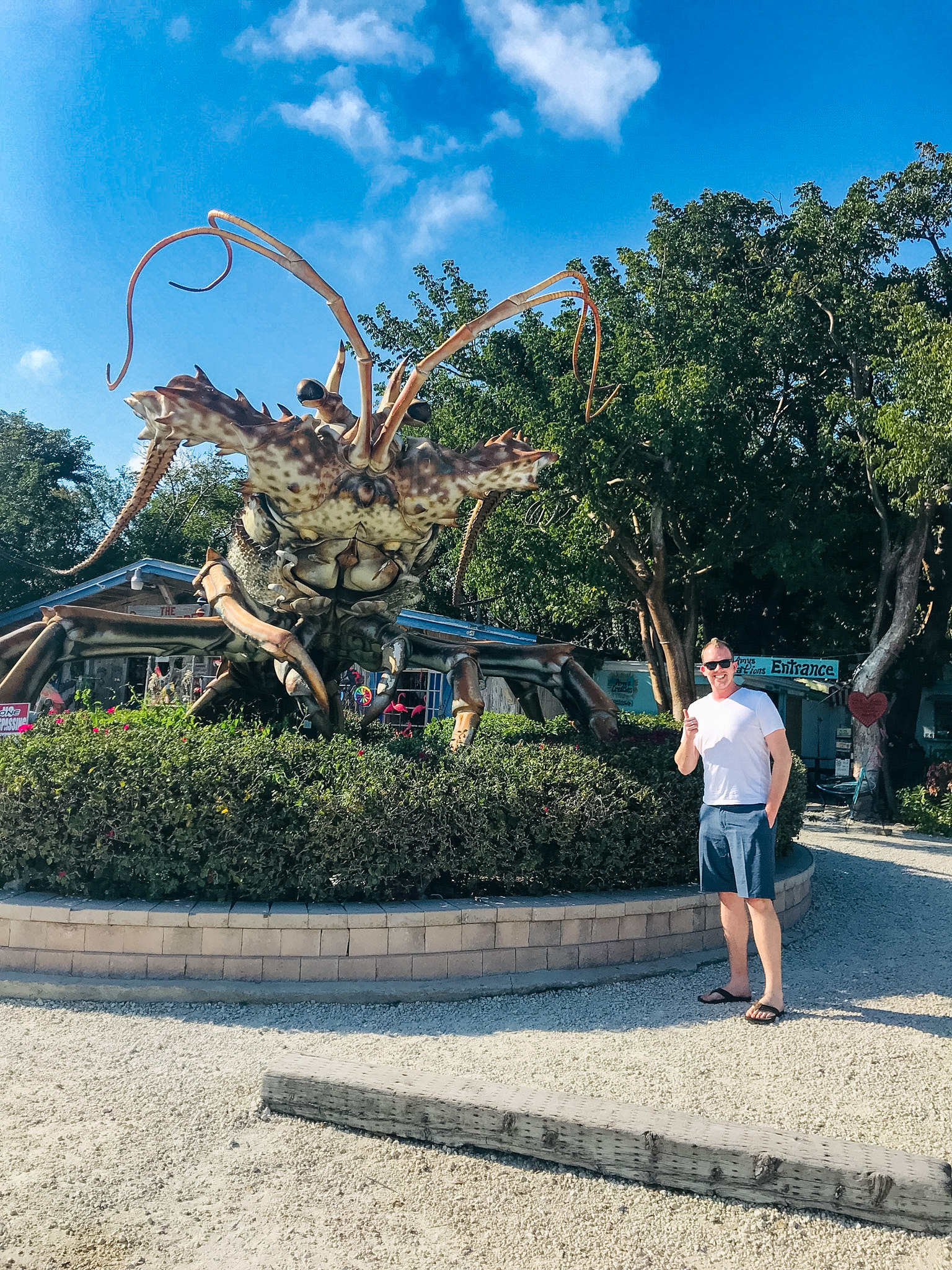
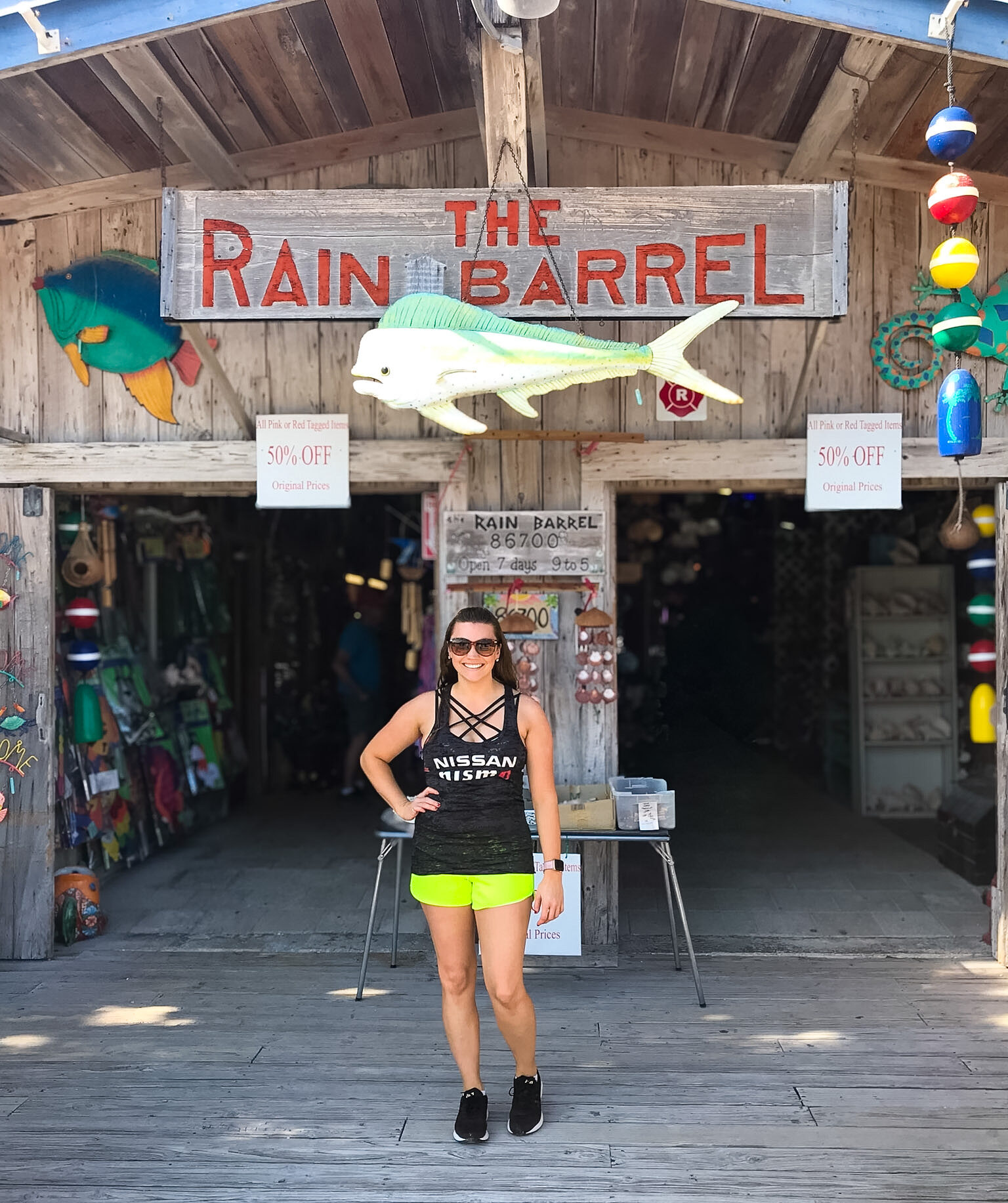
Rain Barrel Village in Islamorada is one of the most fun roadside stops in the Florida Keys.
It is located right along the Overseas Highway and is best known for Betsy the Lobster, the giant lobster sculpture that has become one of the most photographed landmarks in the Keys.
Even if you only stop for a few minutes, it is worth pulling over for a photo with Betsy.
The village itself has local shops, art galleries, gardens, specialty stores, handmade crafts, souvenirs, tropical gifts, and small businesses. Walking through the property feels a little like exploring an outdoor market, with colorful artwork, tropical landscaping, and quirky details throughout the property.
Rain Barrel Village is located in Islamorada near Mile Marker 86, which makes it an easy stop if you are driving between Key Largo and Key West.
My tip: even if you are not planning to shop, stop long enough to take a picture with Betsy the Lobster. It is a classic Florida Keys photo stop, and you will see it in travel guides and all over social media for a reason.
A small foldable bag like the Nano Bag is useful here if you end up buying souvenirs or gifts and do not want random purchases rolling around your car for the rest of the drive.
Sunset Grille is located in Marathon at the foot of the Seven Mile Bridge, and it is known for having some of the best bridge views in the Florida Keys.
This is a great place to stop for lunch, dinner, or a drink while enjoying one of the most iconic views on the drive.
The location is the main reason to stop here. Being right near the Seven Mile Bridge makes it a practical break point between the Upper Keys and Lower Keys.
If you are timing your drive around a meal, this is one of the easiest places to build into the route.
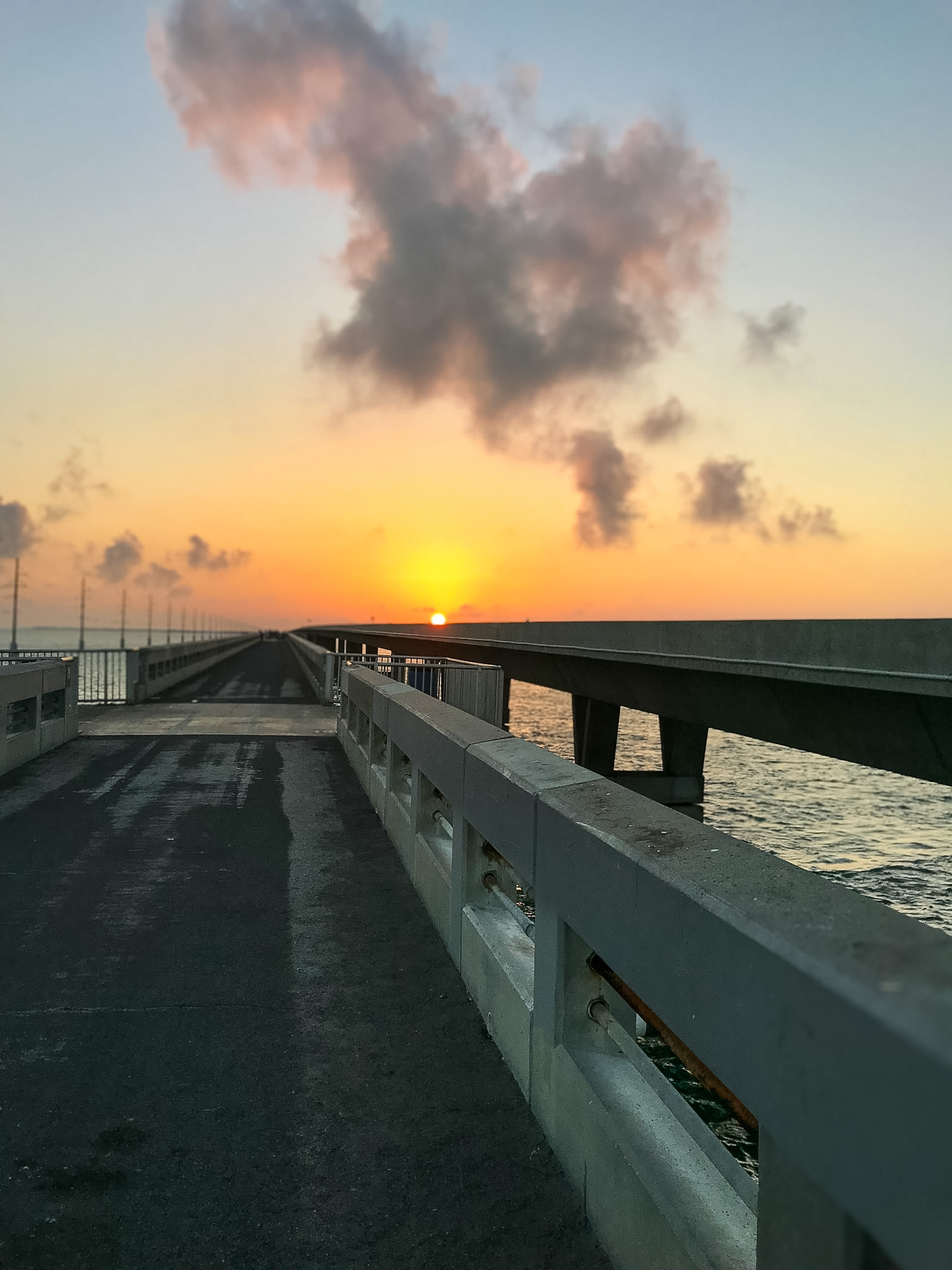
Even if you stop nowhere else, driving across the Seven Mile Bridge is worth the trip.
Seeing water stretch out in every direction while crossing one of the most famous bridges in the country is something every Florida Keys visitor should experience at least once.
This is the part of the drive that really makes you feel like you are in the Keys. The road is surrounded by water, and the views are completely different from most other drives in Florida.
You do not have to do anything complicated here. Just drive across the bridge and enjoy it.
If this is the part of the drive you are most excited about, read my full Driving the Seven Mile Bridge guide before you go.
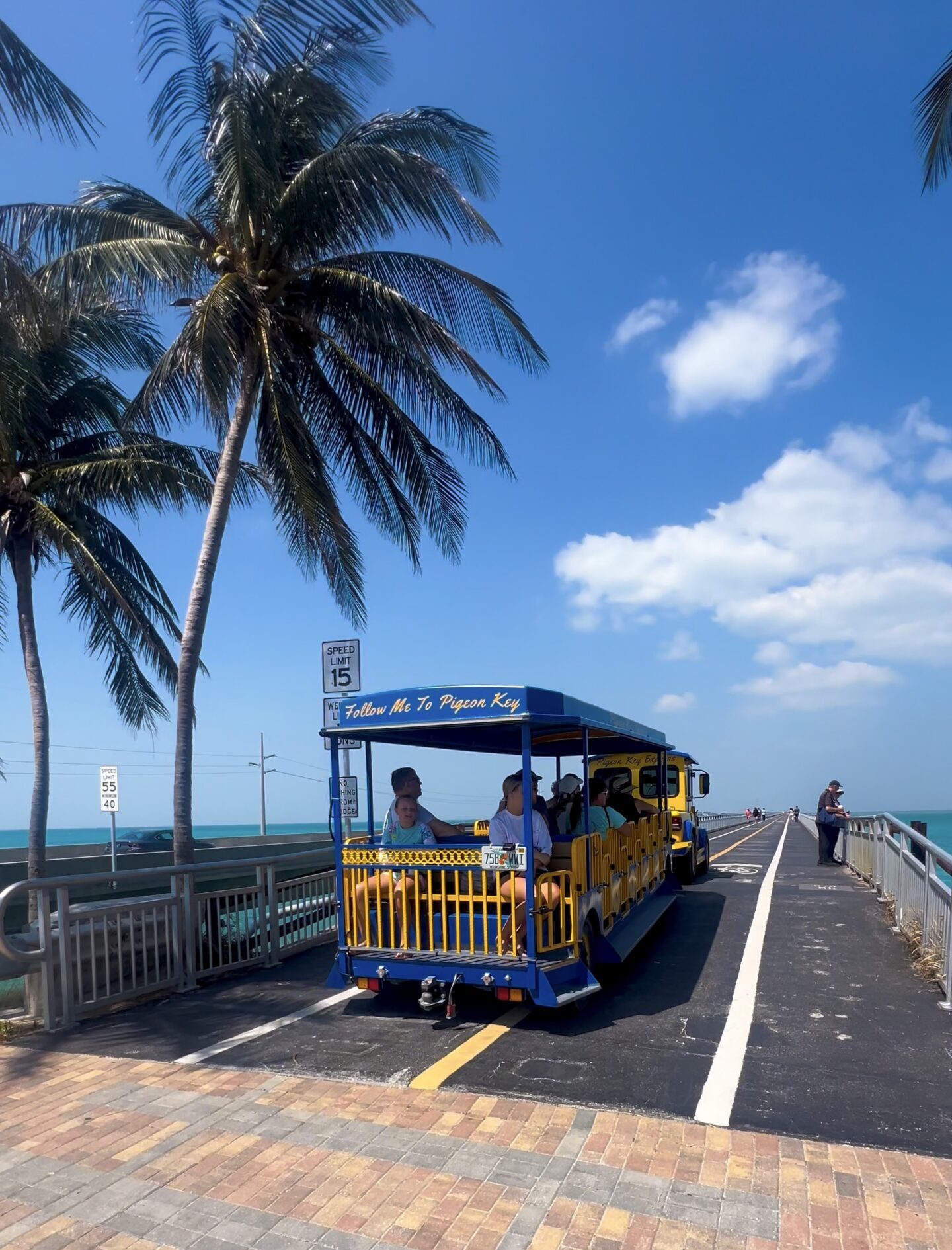
Pigeon Key is located beneath the Seven Mile Bridge and is one of the most interesting historical attractions in the Florida Keys.
Visitors can ride a small train that departs near the old Seven Mile Bridge and travels about a quarter mile across the bridge before arriving at Pigeon Key.
The guided tour explains the history of Henry Flagler’s Overseas Railroad and the workers who helped build one of the most ambitious engineering projects in American history.
If you like history, this is one of the better stops to add to the drive because it gives context to the bridges, railroad, and engineering that shaped the Florida Keys. Bring a sandwich and enjoy lunch with the views. That is my kind of history stop.
Save this for later on Pinterest so you don’t forget it.
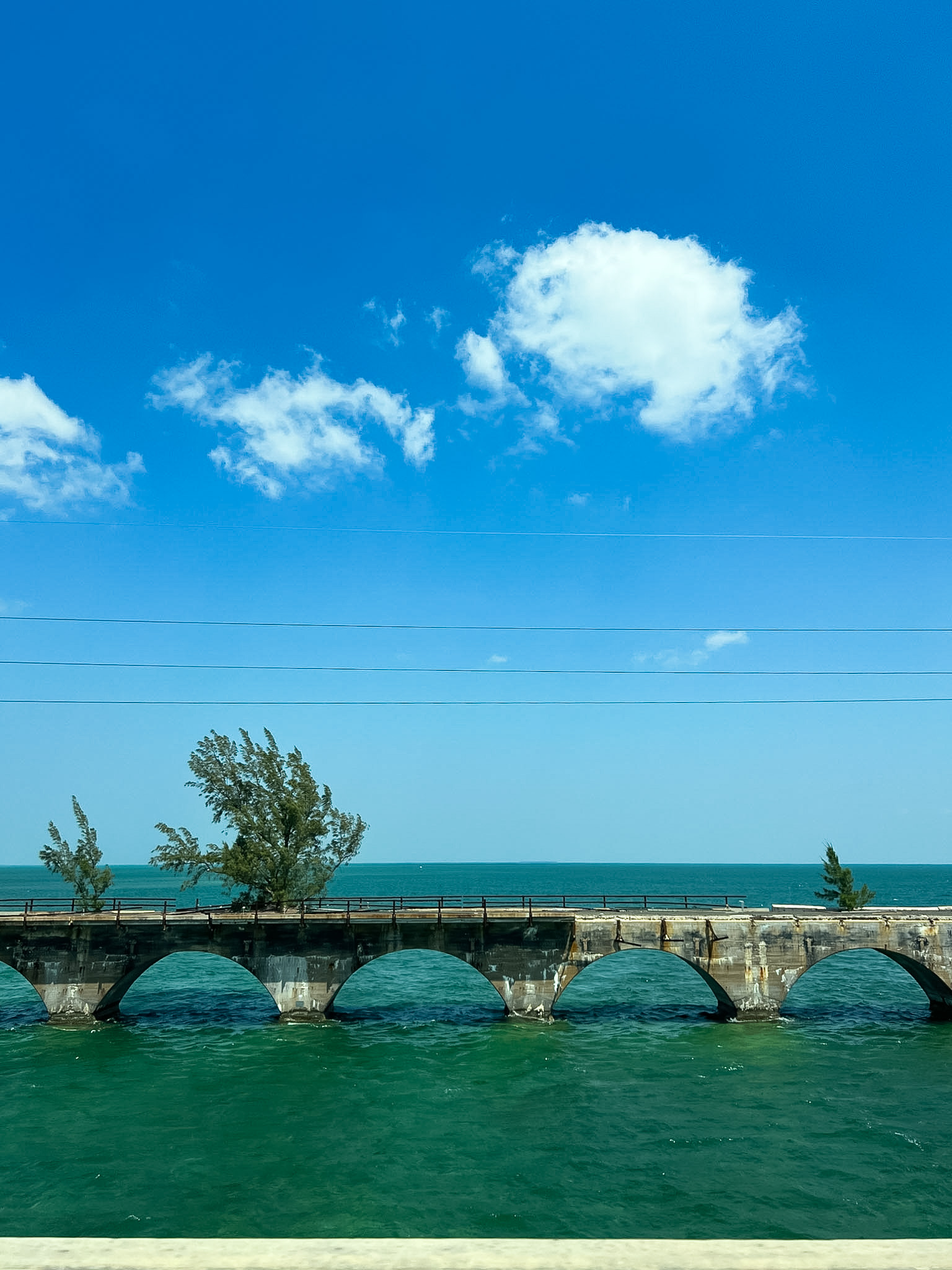
Yes, a tree made this list.
Fred the Tree grows from an old bridge support and has become a Florida Keys celebrity. He has his own Instagram account, appears in a children’s book, was featured in the Road House movie, and locals decorate him every Christmas.
It is a quick stop, but it is also a Florida Keys story you remember after the trip.
If you are already visiting Big Pine Key, consider making a stop at No Name Pub.
Originally established in the 1930s, this quirky restaurant is famous for the thousands of dollar bills covering its walls and ceilings.
It is one of the most unique dining experiences in the Florida Keys and works well as a casual meal stop if you are already detouring through Big Pine Key.
This is not a polished waterfront restaurant stop. It is more of a weird, memorable, old-Florida-style stop, which is exactly why people like it.
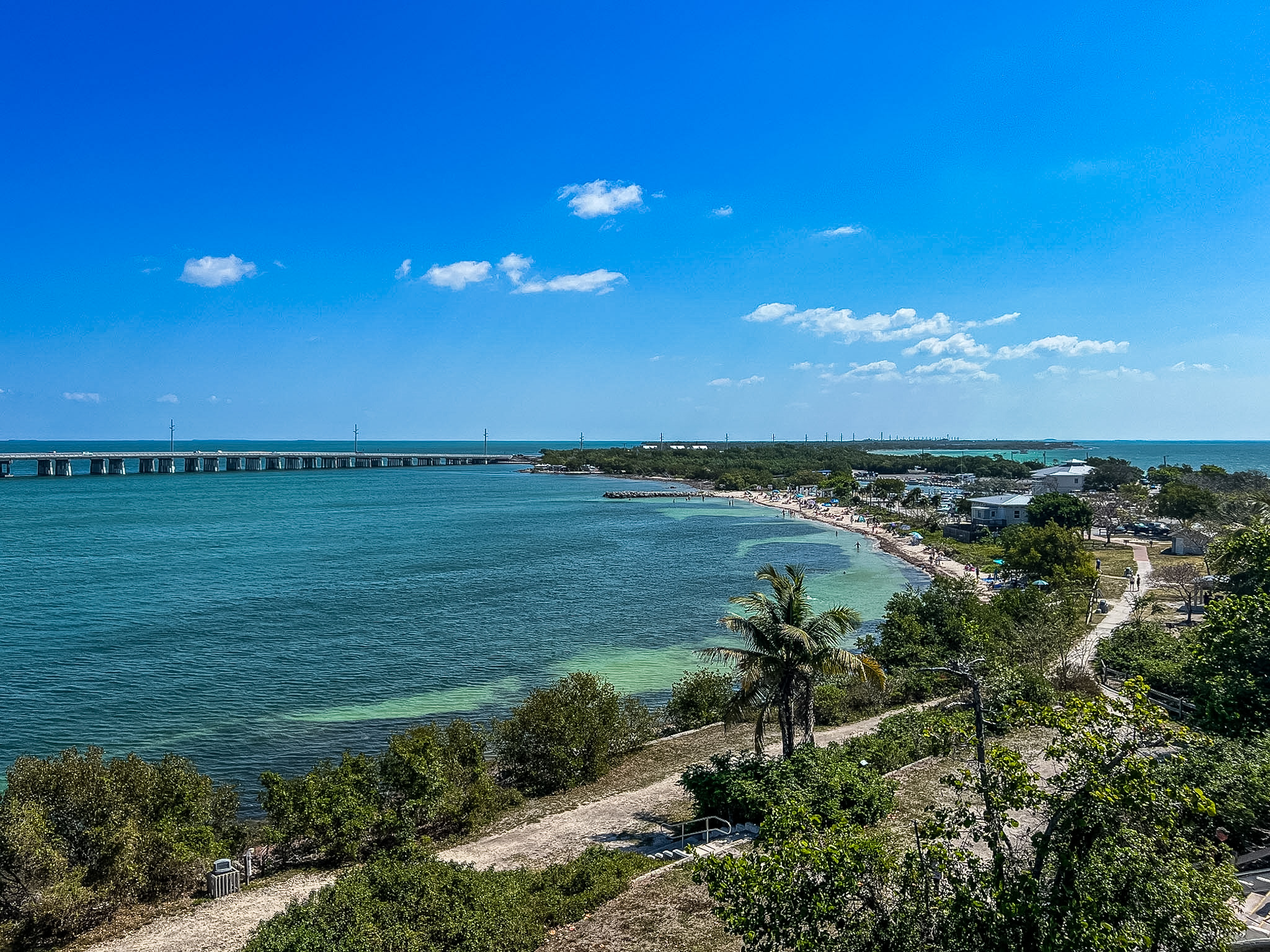
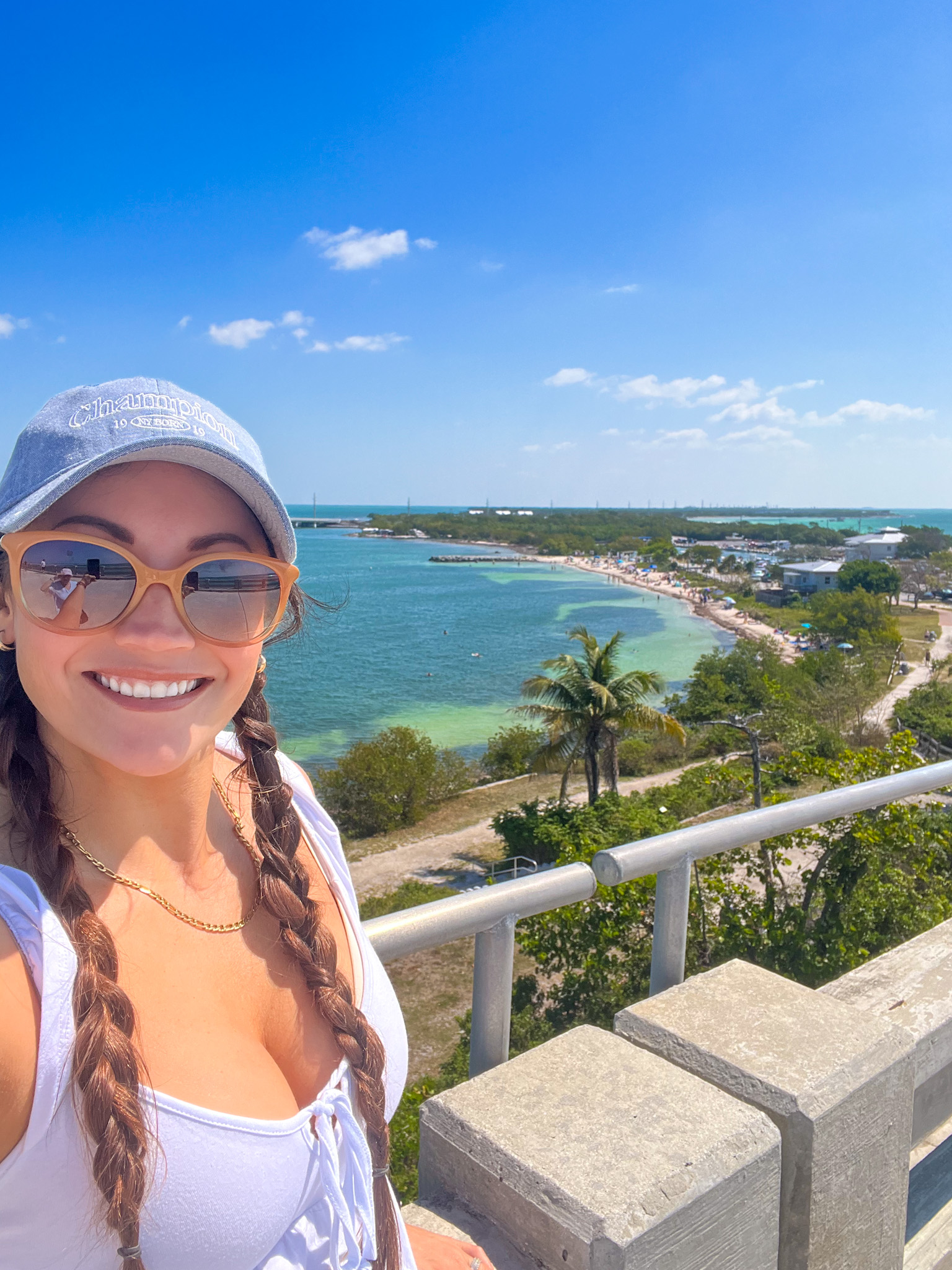
Bahia Honda State Park is one of the prettiest places in the Florida Keys.
The beach is beautiful, the water is crystal clear, and the old Bahia Honda Bridge creates one of the most iconic views in the Keys.
Admission is also very reasonable. During our visit, entry ranged from about $4.50 for a single visitor to around $10–12 per vehicle depending on the number of people.
Considering the beaches, scenic views, old bridge overlook, and snorkeling opportunities, it felt like one of the best values in the Florida Keys.
One tip: go early.
We visited ourselves and learned that once the parking lot fills up, the park stops allowing additional vehicles inside. Afternoon visitors can sometimes be turned away simply because there are not enough parking spaces available.
This is not a stop I would save for late afternoon unless you are comfortable with the risk. If Bahia Honda is high on your list, make it one of your earlier stops.
For this stop, I would bring water shoes, a quick-dry towel, and face sunscreen. The beaches are beautiful, but the sun is strong, the water is salty, and some areas can be rocky, so I would come prepared.
Summerland Key Airpark may be the strangest neighborhood in the Florida Keys.
The community is built around a runway, and many homeowners have airplane hangars attached directly to their houses. Instead of driving to the airport, residents can literally taxi from their backyard to the runway.
It is not a major tourist attraction, but aviation lovers will find it fascinating.
This is the type of stop that makes you pause and think, “Wait, people live like this?”
Yes. With planes in their yards.
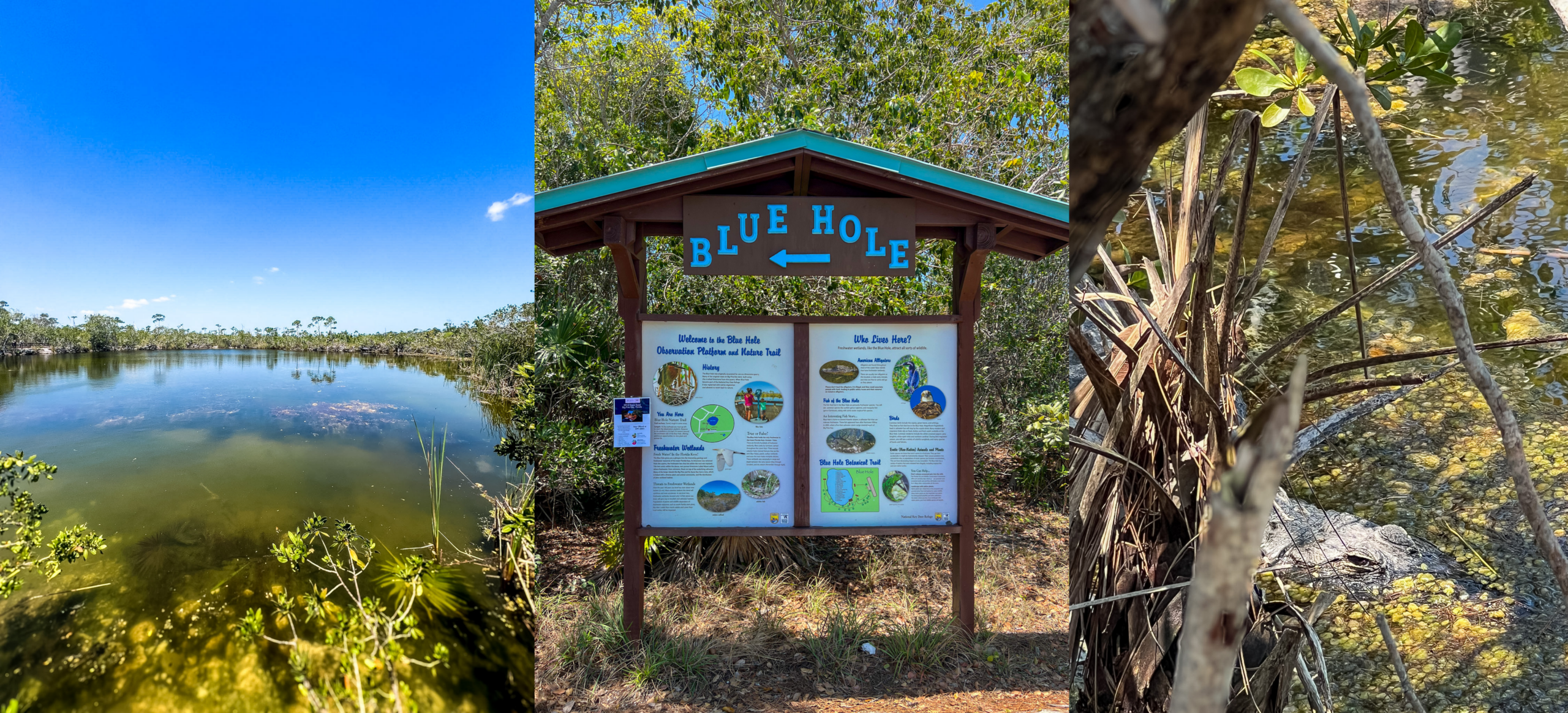
One of the more unexpected stops in the Florida Keys is the Blue Hole on Big Pine Key.
It was originally a limestone quarry used during construction of the Overseas Highway. Over time, it filled with freshwater and became a wildlife habitat inside the National Key Deer Refuge.
The Blue Hole is one of the few places in the Florida Keys where you might see an alligator. You may also see turtles, fish, wading birds, and even Key deer.
There is a short nature trail and an observation platform, which makes it an easy stop if you are driving between Marathon and Key West.
If you are already planning to visit Key Deer Boulevard, I would add the Blue Hole to your itinerary. It only takes about 15 to 30 minutes to explore and shows a completely different side of the Florida Keys than the beaches and snorkeling spots most visitors focus on.
If you are looking for a splurge, Little Palm Island is one of the most luxurious experiences in the Florida Keys.
The private island is only accessible by boat, which makes the experience feel even more exclusive.
Brunch here costs around $250 per person, so it is certainly not cheap. But if you are celebrating a special occasion, it is a unique experience that is hard to replicate anywhere else in Florida.
This is not a casual “let’s just pop in” stop. It is more of a planned splurge, especially if you want something romantic or celebratory during your Florida Keys trip.
For most people driving from Miami to Key West, this will not be a necessary stop. But if I am going to splurge on anything during a trip, food is usually the category where I understand it.
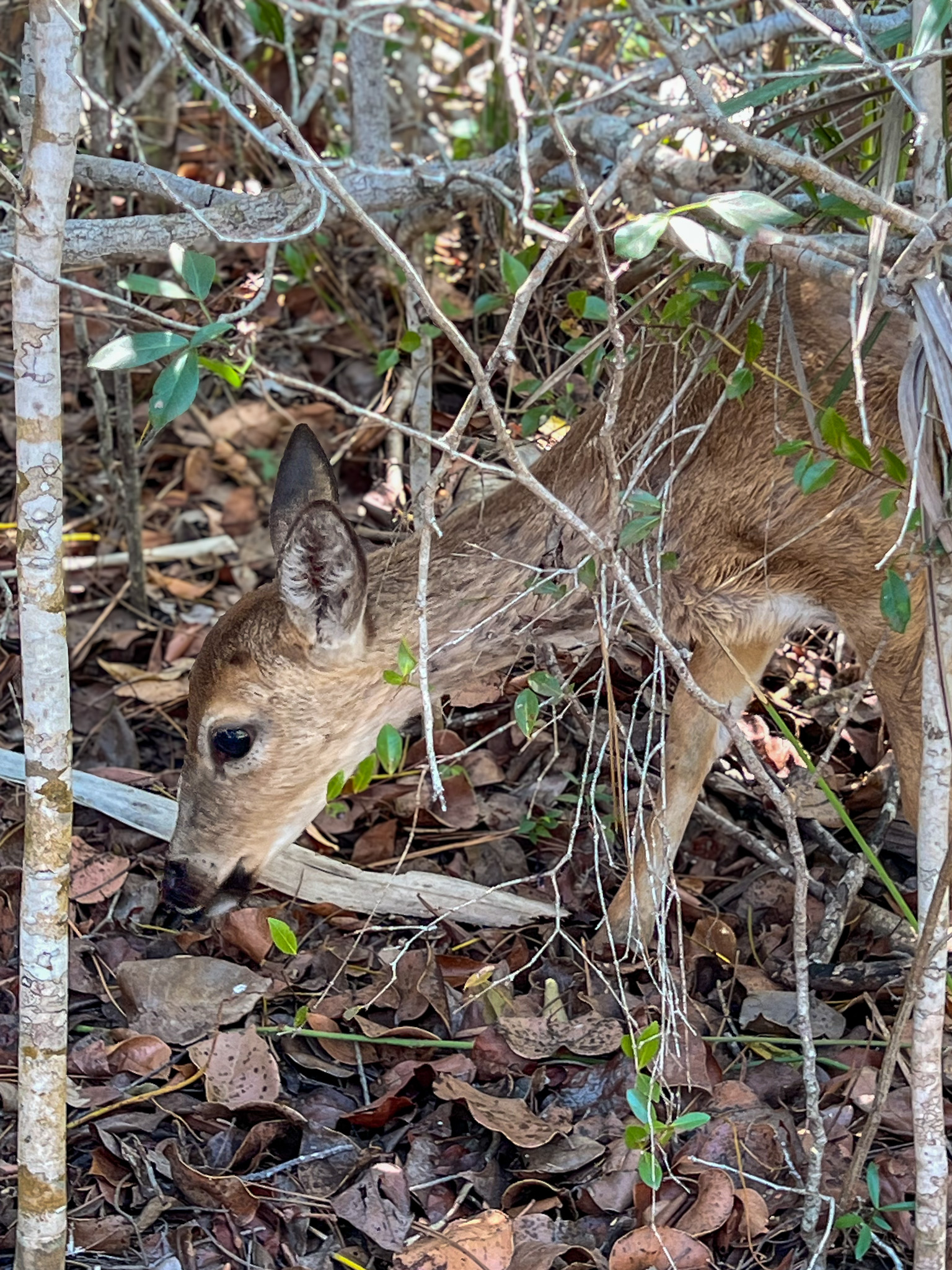
One of the most unique stops in the Florida Keys is Big Pine Key, home to the endangered Key deer.
Key deer are found nowhere else in the world. They are much smaller than most people expect and are one of the Florida Keys’ most famous residents.
The best place to look for them is along Key Deer Boulevard inside the National Key Deer Refuge.
We were told early morning and sunset are typically the best times to spot them, although they can sometimes be seen throughout the day.
If you are driving between Marathon and Key West, this is an easy detour and one of the few wildlife experiences in the Florida Keys that you truly cannot find anywhere else.
Just remember that these are wild animals, even if they are tiny and unusually cute. Keep your distance, drive slowly, and do not feed them.
If you are visiting the Keys in July, consider timing your trip around the Underwater Music Festival.
This annual event combines snorkeling and diving with music broadcast underwater.
It is quirky, completely unique, and one of the most Florida Keys experiences you can have.
This is not something that will fit every itinerary, but if your dates line up and you like unusual travel experiences, it would be a fun reason to plan your drive through the Keys around July.
If you are driving from Miami to Key West in one day, I would choose three to five stops.
That gives you enough time to enjoy the drive without turning the day into a constant cycle of parking, getting out, taking a photo, getting back in the car, and repeating until everyone is tired and mildly annoyed.
For a first-time Florida Keys drive, I would prioritize a mix of food, scenery, and one unique Keys experience.
A good first-time route could include Blonde Giraffe Key Lime Pie Factory, Rain Barrel Village and Betsy the Lobster, Robbie’s Marina, Seven Mile Bridge, and either Bahia Honda State Park or Key Deer Boulevard.
If you have more time, add Pigeon Key, Blue Hole, No Name Pub, or John Pennekamp Coral Reef State Park.
If you are short on time, I would focus on the Seven Mile Bridge, one food stop, and one roadside stop. That keeps the drive interesting without turning it into a full-day mission.
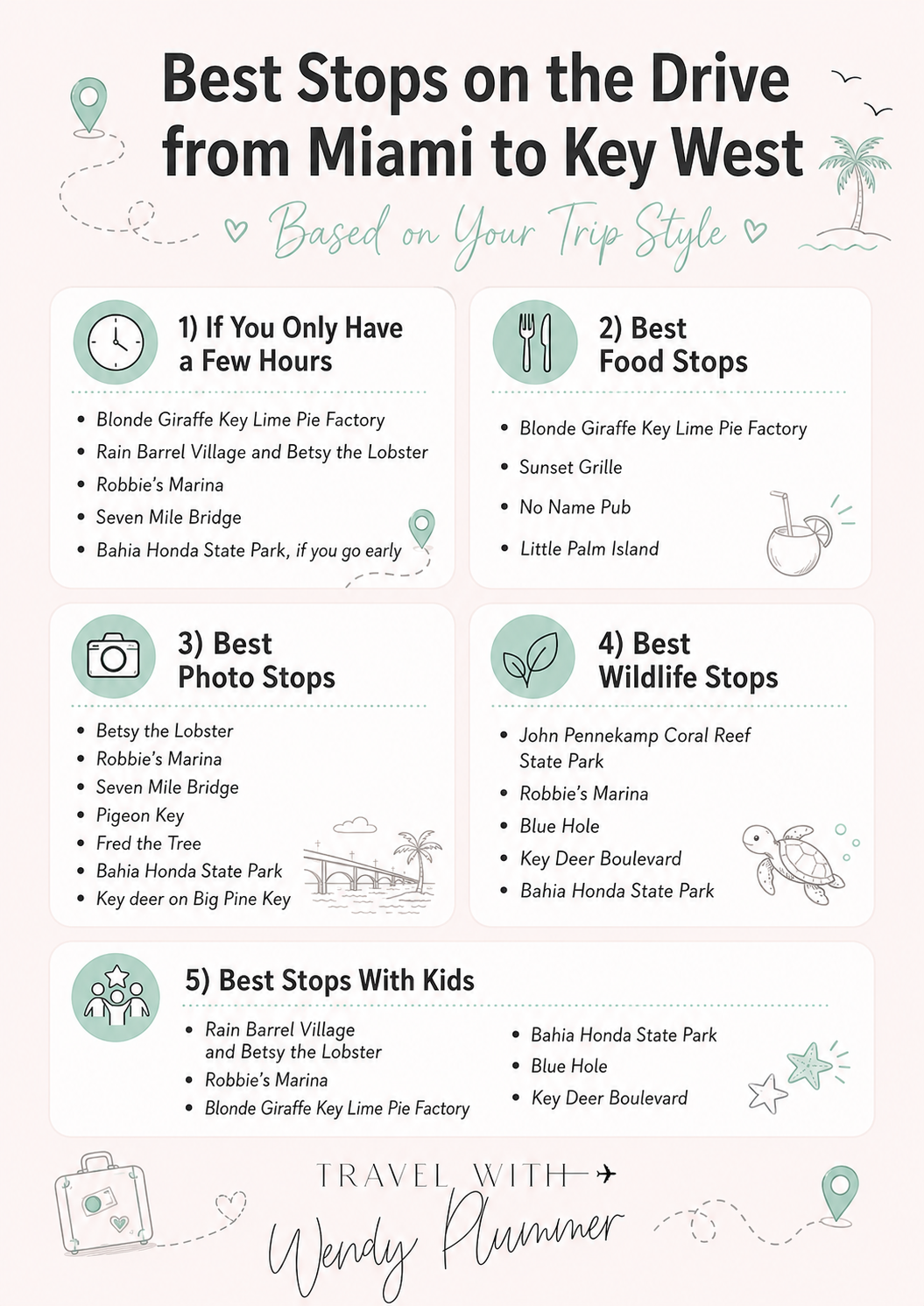
The drive from Miami to Key West is more than just the road to get there.
Between key lime pie, giant tarpon, bridge views, state parks, tiny deer, strange neighborhoods, and a famous tree, the Overseas Highway has plenty of stops that make the trip feel memorable before you even reach Key West.
For a first-time drive, I would keep the itinerary realistic. Choose a few stops that match your travel style instead of trying to do everything.
My personal priorities would be key lime pie, the Seven Mile Bridge, Bahia Honda if you can go early, and at least one weird Florida Keys stop.
Because honestly, if a tiny deer and a famous tree are both options, I am going to need to see at least one of them.
If you end up booking anything for your trip, using my affiliate links helps support my blog at no extra cost to you. I spend a lot of time researching and writing these guides, so I really appreciate the support.
For flights into South Florida, I usually compare options through Skyscanner. If you are renting a car for the Florida Keys drive, check Discover Cars.
If you still need a place to stay before or after the drive, you can compare hotels through Booking.com or Hotels.com.
For help choosing your base once you get to Key West, read What Areas to Stay in Key West.
For snorkeling tours, boat trips, food tours, or guided activities in the Keys, I would compare options through Viator and Get Your Guide.
For a Florida Keys road trip, I would pack sunscreen, a reusable water bottle, a small beach bag, and anything you need for water stops. A Brita Water Bottle, dry bag, and quick-dry towel are especially useful if you are planning beach or snorkeling stops.
For a more complete packing breakdown, read What to Pack for Key West in May (What I Actually Used and What I Didn’t).
If this drive is part of a bigger Key West trip, these guides will help with the rest of your planning:

“Outside Terminal 3” is not a pickup location at PHX.
Before your driver pulls in, text them four things: your terminal, north or south side, door number, and inner or outer curb. Grab your bags first, then call them in. Drivers can wait free in the cell phone lot instead of circling. Getting through security is easy; getting picked up is the hard part.
Save this for your Phoenix trip ✈️

Come for the architecture, stay for the view.
The Chapel of the Holy Cross has been built into Sedona’s red rocks since 1956. The outside overlooks get busy, but inside is quiet, with huge windows framing the rocks. It’s free, takes 30-45 minutes, and has a paved, wheelchair-accessible ramp. Make sure to bring water in summer.
Save this for your trip planning!
Order it well done. Trust me.🍑🍕
Peach & Pancetta Pizza at Hideaway House in Sedona: roasted peaches, salty pancetta, ricotta, basil, extra-crispy crust. Split the house salad, grab a prickly pear lemonade, and get a patio table facing the red rocks. Skip the bread if you want room for another slice.
Save this for your Sedona trip✈️
Pack your bags, Denver is not just a mountain layover. RiNo alone can eat a full day between the murals, food, and bars. Skip the concert and hit Red Rocks midday instead, you’ll basically have it to yourself. Golden’s a 30-minute trip if you want a change of pace, and if food drives your travel like it does mine, Denver Central Market and BRUTØ deserve real time on the calendar. Give it three days minimum, four if you’re eating your way through it. Save this.
Stayed at The Maven in Denver’s Dairy Block and the location alone sold me, walking distance to Union Station and most of downtown, string lights right outside at night. The room was spacious and quiet, even had a swing in it. Real talk though, there’s a $28 daily resort fee and parking isn’t cheap, valet ran us $59 a day. Bed was a little firm, but that’s the only complaint I’ve got. Save this before you book.

Follow @travelwithwendyplummer for Beautiful Beach Destinations, City Guides, Foodie Spots, and Luxury Hotel Recommendations.